The Definitive Guide to the WPPSI-IV and WPPSI: Understanding Early Childhood Cognitive Assessment
When it comes to understanding the developing mind of a young child, few tools are as widely respected and utilized as the Wechsler Preschool and Primary Scale of Intelligence, commonly known as the WPPSI. For parents and educators alike, navigating the world of cognitive assessments can be daunting. Terms like "IQ tests" often carry heavy implications, but modern instruments like the current version, the WPPSI-IV, are designed to be comprehensive, engaging, and insightful tools for mapping a child's unique cognitive strengths and weaknesses.
This comprehensive guide will walk you through everything you need to know about the WPPSI-IV, its evolution from previous WPPSI versions, what it measures, and what to expect during the assessment process.

What is the WPPSI?
The Wechsler Preschool and Primary Scale of Intelligence (WPPSI) is an individually administered standardized test designed to assess the cognitive functioning of young children. It is part of the famous "Wechsler family" of intelligence scales, which also includes the WISC (for older children) and WAIS (for adults).
It is important to understand that the WPPSI is not just about generating an IQ score. It is a clinical tool used by school psychologists, clinical psychologists, and neuropsychologists to:
- Identify intellectual giftedness.
- Diagnose learning disabilities or developmental delays.
- Gain insight into a child’s cognitive processing style to tailor educational interventions.
- Determine eligibility for specialized school programs.
Who is the WPPSI For? (The Age Range)
The current version, WPPSI-IV, covers a specific age range of children from 2 years and 6 months up to 7 years and 7 months. Because the developmental differences between a two-year-old and a seven-year-old are vastly different, the test is divided into two distinct age bands with separate test structures:
- Ages 2:6 – 3:11: Focuses less on verbal output and speed, using more tangible, engaging materials tailored for shorter attention spans.
- Ages 4:0 – 7:7: Includes a broader range of subtests demanding longer attention and more complex verbal and reasoning skills.
The Evolution from WPPSI to WPPSI-IV
You may see references to both "WPPSI" and "WPPSI-IV." The WPPSI-IV (Fourth Edition) is the most current version released in 2012. It replaced the WPPSI-III.
Psychological tests must be updated periodically. This is done to ensure the norms (the comparative data) reflect the current population—known as the "Flynn Effect," IQ scores tend to rise over time, so tests must be recalibrated. The move to WPPSI-IV also introduced significant improvements based on modern research into child development and working memory.
Key Improvements in the WPPSI-IV:
- New Working Memory Subtests: A greater emphasis on evaluating a child's ability to hold and manipulate information temporarily.
- Reduced Emphasis on Speed: For the younger age band, timed tasks were minimized to reduce anxiety and more accurately measure ability rather than motor speed.
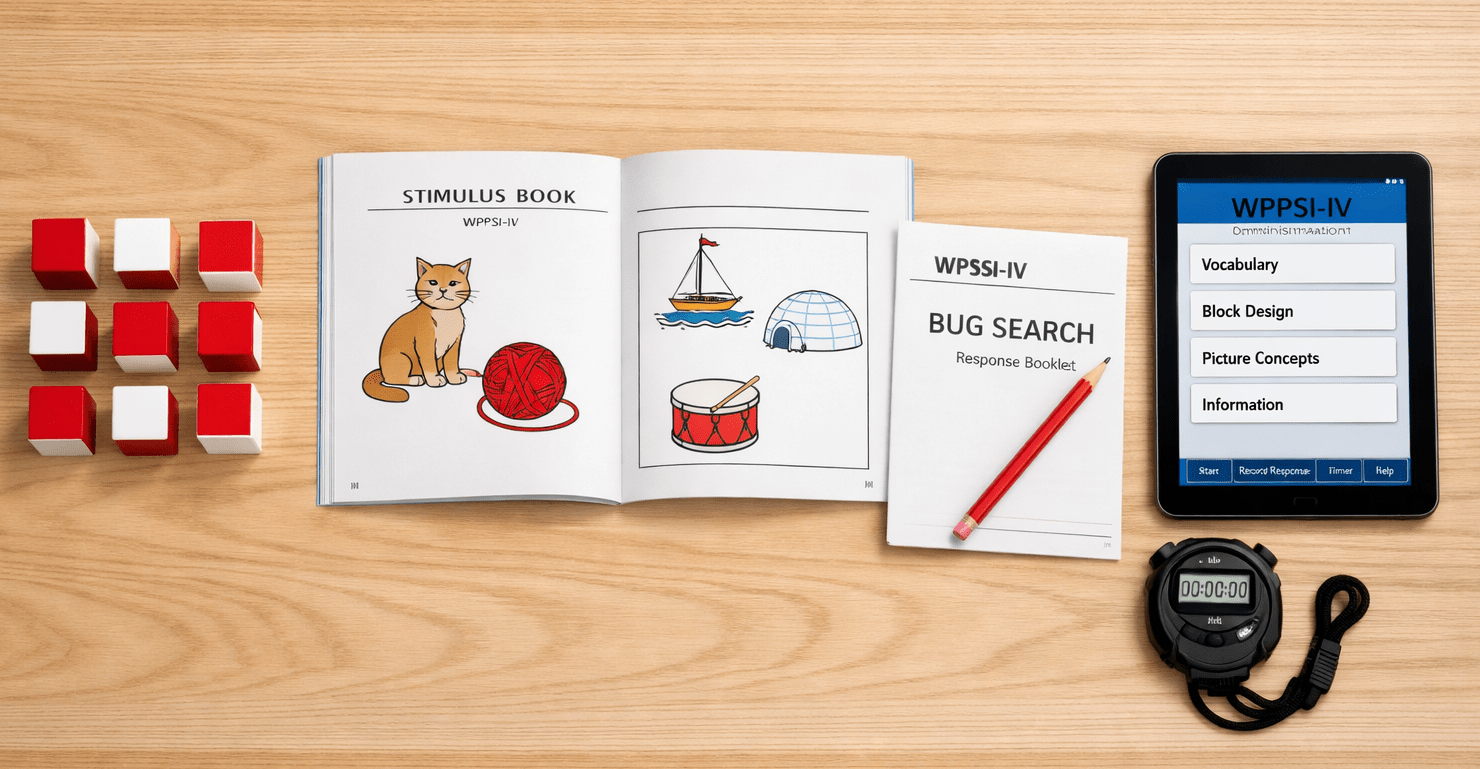
- Digital Integration: While much of the test remains physical (blocks, booklets), the WPPSI-IV introduced digital formats for presenting certain visual stimuli, modernizing the administration process.
The Structure of WPPSI-IV: What is Measured?
The WPPSI-IV does not just produce one "Full Scale IQ" score. It provides a profile made up of several Primary Index Scales. These indices are derived from various "subtests"—activities that look like puzzles or games to the child.
For children aged 4:0 to 7:7, the test is broken down into five primary cognitive domains:
| Primary Index Scale | What It Measures | Example Activity Types |
|---|---|---|
| Verbal Comprehension Index (VCI) | The ability to understand and use verbal language, access word knowledge, and form concepts. | Defining words; identifying commonalities between two concepts; answering general knowledge questions. |
| Visual Spatial Index (VSI) | The ability to analyze and manipulate visual information and solve non-verbal spatial problems. | Recreating designs using colored blocks; putting puzzles together. |
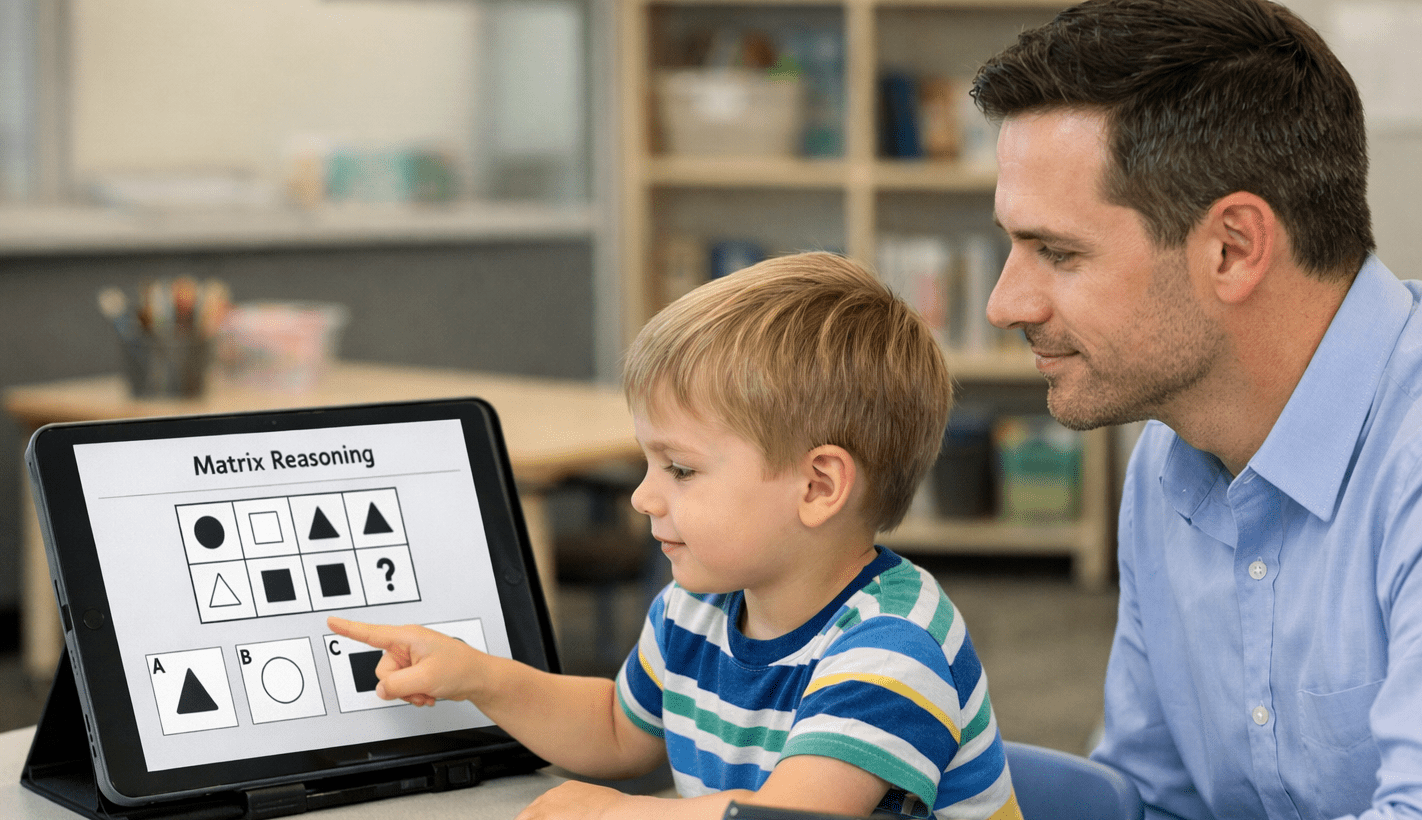
| Fluid Reasoning Index (FRI) | The capacity to detect underlying conceptual relationships among visual objects and use reasoning to identify rules. (Thinking outside the box). | Completing matrix patterns by selecting the missing piece; recognizing visual categories. |
| Working Memory Index (WMI) | The ability to register, maintain, and manipulate visual and auditory information in the mind temporarily. | Looking at pictures and remembering their locations; repeating sequences of numbers or images. |
| Processing Speed Index (PSI) | The speed and accuracy at which a child can process simple visual information and make simple decisions with their hands. | Quickly scanning a page to mark specific symbols or animals within a time limit. |
Note: For the younger age band (2:6–3:11), the Working Memory and Processing Speed indices are not typically administered to calculate the Full Scale IQ.
The Testing Experience: What Happens During the Assessment?
For parents, the biggest source of anxiety is often the unknown. What will the experience actually be like for the child?
A WPPSI-IV administration takes anywhere from 30 minutes (for younger children doing the basic battery) to over an hour for older children completing all subtests. It is crucial that the test is administered by a qualified professional, usually a licensed psychologist, in a quiet, distraction-free environment.
To a young child, the WPPSI rarely feels like a "test." The examiner's goal is to build rapport and make the child feel comfortable. The activities change frequently—moving from answering questions to building with blocks, to looking at pictures—to keep the child engaged.
If a child becomes fatigued, anxious, or uncooperative, a skilled examiner will take breaks or, in some cases, discontinue testing. The validity of the results depends on the child's optimal effort and engagement.

Scoring and Interpretation
Once the assessment is complete, the psychologist scores the subtests and converts them into standardized scores based on the child's exact age. You will typically receive a report detailing:
- Full Scale IQ (FSIQ): A composite score representing general intellectual functioning. The average score is set at 100, with a standard deviation of 15. Most children score between 85 and 115.
- Index Scores: Scores for the five domains listed above (VCI, VSI, etc.), which highlight strengths and weaknesses.
- Qualitative Observations: The psychologist's notes on the child's focus, frustration tolerance, anxiety, and problem-solving approach during the session.
It is vital to remember that a WPPSI score is a snapshot of performance on a specific day. While generally stable, scores can change as a child develops. A score should never be used to limit a child’s potential, but rather to understand the best ways to support their learning.
Preparing for the WPPSI-IV: The Do's and Don'ts
When parents learn their child will take the WPPSI, the immediate instinct is often to "prepare." However, due to the nature of these tests, traditional studying is neither effective nor recommended.
Don't:
- Do not try to "teach to the test." Exposing a child to specific test materials beforehand invalidates the results. The test measures novel problem-solving, not learned knowledge.
- Do not build anxiety. Avoid telling the child it is an important test or that they must do well.
Do:
- Ensure a good night's sleep and a healthy breakfast before the appointment.
- Frame it positively. Tell the child they are going to play some "brain games" with a nice person who wants to see how they think.
- Ensure hearing and vision checks are up to date before the assessment to ensure no physical barriers interfere with performance.
Conclusion
The WPPSI-IV is a powerful, scientifically backed instrument that provides invaluable insight into early childhood cognitive development. Whether used for identifying giftedness or pinpointing learning challenges, the WPPSI helps parents and educators move beyond guesswork, providing a roadmap to better support a child's unique learning journey during these critical formative years.