What IQ is Considered Genius? (Official Score Chart & Signs)
What IQ Score is Considered Genius? (Official Classification Guide)
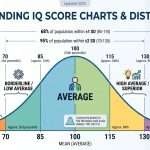
When people ask, "What IQ is considered genius?", the answer depends slightly on which IQ scale is referenced. However, in most standard psychological assessments, a High IQ score of 140 or higher is officially classified as "Genius" or "Near-Genius."
While the average adult IQ sits between 85 and 115, a genius score places an individual in the top 0.25% of the population. This level of intelligence indicates exceptional ability in pattern recognition, abstract reasoning, and problem-solving.
Curious where you stand on the bell curve?
Most people are surprised by their results.
To understand what constitutes a high IQ, it helps to look at the official classification used by standardized tests like the Wechsler IQ Test and Stanford-Binet.
Is there a limit to how smart a human can be? While standard tests often cap out around 160, there have been historical anomalies. A score of 200+ is theoretically possible but extremely difficult to measure accurately.
The highest recorded scores often belong to individuals who excel in advanced mathematics and physics at a very young age. To learn more about the theoretical upper limits of human intelligence, read our full guide on The Highest IQ Possible.
Common Traits of Genius Level Intelligence
A high score isn't the only indicator of genius. Psychologists have identified several behavioral traits that often accompany a high intellect. If you recognize these signs, you may be in the upper percentiles:
Rapid Learning: The ability to grasp complex concepts quickly without needing repetition.
High Adaptability: The ability to adjust to new situations and solve problems with limited information.
Curiosity: An insatiable drive to understand "why" things work, often leading to deep dives into niche subjects.
Pattern Recognition: Seeing connections between unrelated topics that others miss. This is often tested in Spatial Intelligence Tests.
Memory: Exceptional working memory and the ability to recall detailed information.
Is 130 or 140 the Cut-Off?
There is often confusion between the terms "Gifted" and "Genius."
130 IQ: This is the widely accepted Mensa Minimum IQ requirement. If you score 130 or higher, you are considered "Gifted" and rank in the top 2% of the population.
135 IQ to 140 IQ: This is the traditional benchmark for "Genius." Historically, psychologists like Lewis Terman used 140 as the threshold for potential genius-level creativity and intellect.
Famous People and Their Estimated IQs
While many historical figures never took a modern standardized test, psychologists have estimated their scores based on their works and accomplishments.
Marilyn Monroe: Estimated 165 (Often cited as higher than Einstein)
Elon Musk: Estimated 155
Steve Jobs: Estimated 140+
Signs of a Child Genius
Many parents wonder if their child is gifted. While an IQ by Age comparison is the best way to know for sure, early signs often include:
Reading at a very early age (hyperlexia).
An unusually large vocabulary for their age group.
Asking complex questions about the world/universe.
Preferring the company of older children or adults.
Can You Increase Your IQ to Genius Level?
A common question is whether your genius potential is fixed at birth or if it can be improved. Recent research suggests that while fluid intelligence (processing speed) peaks in early adulthood, crystallized intelligence (knowledge) continues to grow.
While you cannot jump from an average score to a genius score overnight, you can maximize your cognitive potential. Read our analysis on Can You Increase Your IQ? for actionable tips.
Conclusion: Does IQ Matter?
Whether you have a "Genius" score or simply a good IQ score, the most important factor is how you use it. Engaging in strategy games and puzzles is a proven way to maintain cognitive health.
Want to test your logic skills right now? Try our Impossible Tic Tac Toe Game against the computer to see how sharp your mind is today.