GPA Calculator: Calculate Your High School & College Grades
Whether you are aiming for the Dean's List in college or trying to figure out your chances of getting into an Ivy League university, your Grade Point Average (GPA) is the most critical metric of your academic career. Our free GPA Calculator makes it simple to track your academic progress, project your final semester grades, and understand how your individual classes impact your cumulative score.
Use the tool above to calculate your high school or college GPA instantly. Below, we've put together a comprehensive guide explaining exactly how GPA calculations work, the difference between weighted and unweighted scales, and strategies to improve your academic standing.
How to Use This GPA Calculator
Figuring out your GPA doesn't require a spreadsheet or complicated math. Our calculator does the heavy lifting for you in real-time. Here is exactly how to use it:
Enter Your Course Name:
Start by entering the name of your class
(e.g., "Biology 101" or "AP US History").
This is optional but helps you keep track
of your inputs.
Select Your Letter Grade:
Use the dropdown menu to choose your
anticipated or final letter grade
(A+, A, A-, B+, etc.).
Input Course Credits:
Enter the credit value or "weight" of
the class. For high school, a year-long
class is typically 1 credit, while a
semester class is 0.5. For college,
most standard classes are 3 or 4 credits.
Choose Your Course Type (Weighted Only):
If you are calculating a weighted high
school GPA, mark whether the class is
Regular, Honors, or AP/IB/College level.
The calculator automatically adjusts
the point scale for advanced classes.
Add More Courses:
Click the "+ Add Course" button to add
as many classes as you are taking this
semester.
Review Your Results:
Your cumulative GPA will automatically
update in real-time at the bottom of
the screen!
What is a GPA (Grade Point Average)?
Your Grade Point Average (GPA) is a single, standardized number used by schools and universities to summarize your overall academic performance over a specific period. It is essentially an average of all the grades you've received in your classes, weighted by the number of credits each class is worth.
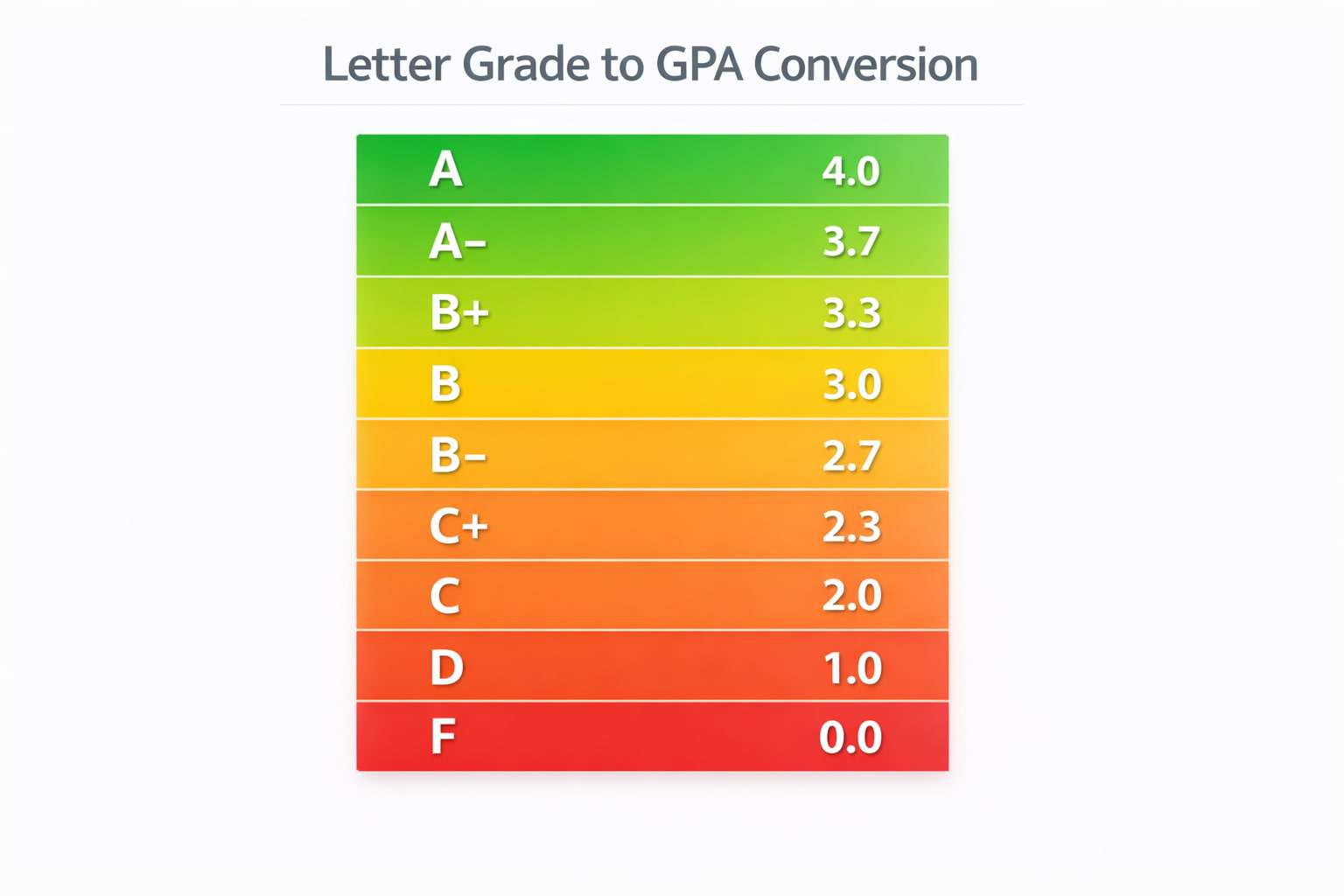
In the United States, GPAs are typically measured on a standard 4.0 scale. On this scale, an "A" translates to a 4.0, a "B" is a 3.0, a "C" is a 2.0, a "D" is a 1.0, and an "F" is a 0.0. This number acts as an immediate signal to college admissions officers, scholarship committees, and potential employers regarding your work ethic, intelligence, and consistency.
Weighted vs. Unweighted GPA: What's the Difference?
When calculating high school grades, you will often hear about two different types of GPAs: Weighted and Unweighted. Understanding the difference is vital for college applications.
The Unweighted GPA
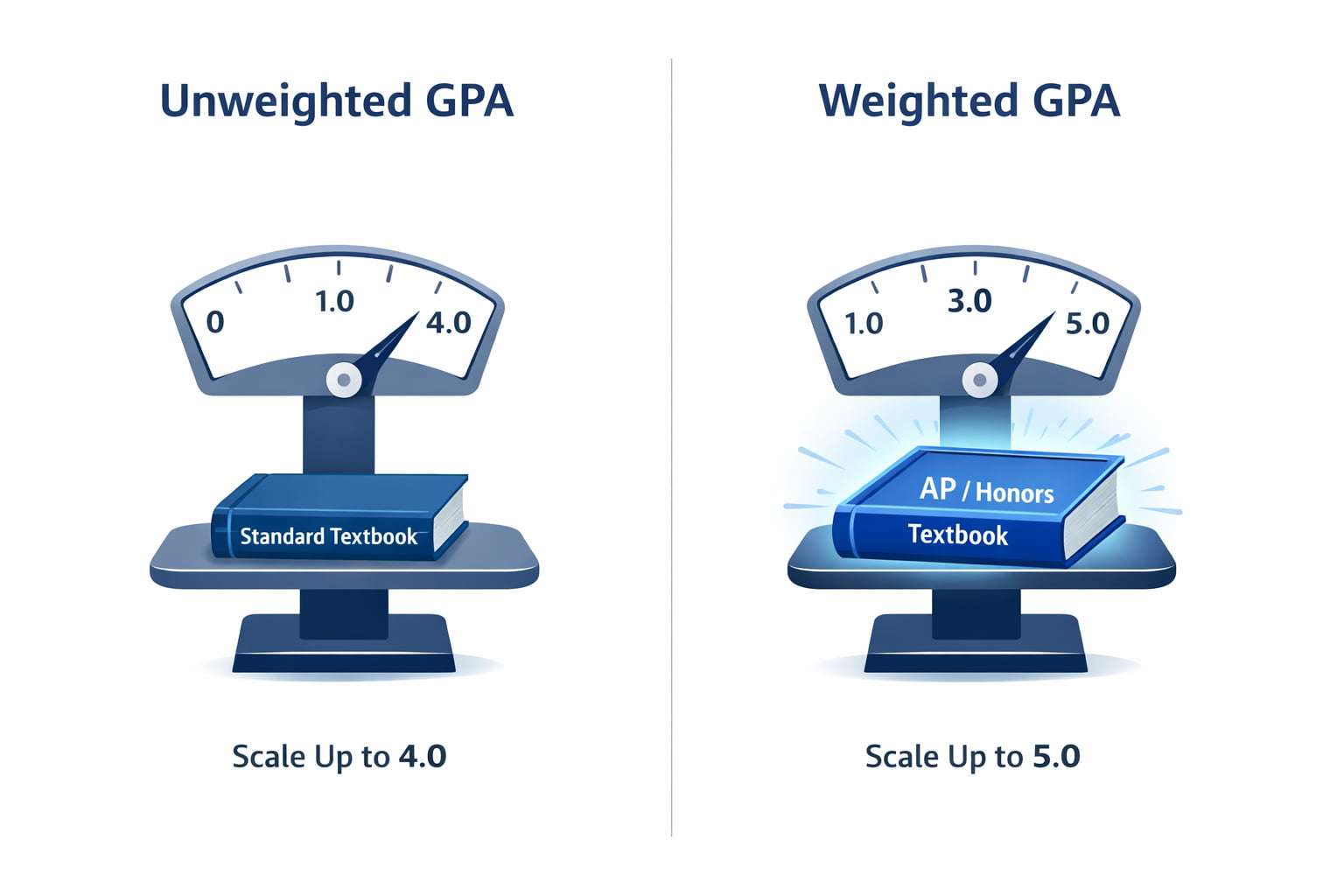
An unweighted GPA calculates your grades on a strict 4.0 scale regardless of how difficult the class is. In an unweighted system, an "A" in basic Physical Education carries the exact same weight as an "A" in Advanced Placement (AP) Calculus. The maximum possible score is a 4.0.
The Weighted GPA
Because an unweighted GPA doesn't reward students for taking rigorous, challenging courses, many high schools use a weighted GPA system. This scale takes class difficulty into account by adding bonus points to your grade values.
Regular Classes:
Standard 4.0 scale (A = 4.0)
Honors Classes:
Adds 0.5 points (A = 4.5)
AP / IB / College Classes:
Adds 1.0 points (A = 5.0)
Using a weighted system, it is entirely possible to graduate with a GPA well over 4.0, which college admissions boards look highly upon as proof of intellectual curiosity and ambition.
The Standard 4.0 GPA Scale Conversion Chart
If you need to manually convert your percentage grades or letter grades into GPA points, use our comprehensive conversion chart below. Note: Some universities and high schools do not use the A+ or A- designations, so check your specific student handbook.
4.0 GPA scale: letter grade, percentage, and weighted point equivalents
Letter Grade
Percentage Score
Unweighted GPA Point
Weighted GPA (Honors)
Weighted GPA (AP/IB)
A+
97 - 100%
4.0
4.5
5.0
A
93 - 96%
4.0
4.5
5.0
A-
90 - 92%
3.7
4.2
4.7
B+
87 - 89%
3.3
3.8
4.3
B
83 - 86%
3.0
3.5
4.0
B-
80 - 82%
2.7
3.2
3.7
C+
77 - 79%
2.3
2.8
3.3
C
73 - 76%
2.0
2.5
3.0
C-
70 - 72%
1.7
2.2
2.7
D+
67 - 69%
1.3
1.8
2.3
D
65 - 66%
1.0
1.5
2.0
F
Below 65%
0.0
0.0
0.0
How is GPA Calculated Mathematically? (The Formula)
If you are curious about the math running behind our calculator tool, the formula is straightforward.
Step 1:
Convert every letter grade you received into
a decimal value using the scale above.
Step 2:
Multiply that decimal value by the number of
Credits the class is worth to
find your "Grade Points" for that class.
Step 3:
Add up all the Grade Points from all your classes.
Step 4:
Add up all the total Credits you took.
Step 5:
Divide the Total Grade Points by the Total Credits.
Example Calculation: Let's say you took three college classes: Biology (4 Credits):
Grade A (4.0) ->
4.0 * 4 = 16 points English (3 Credits):
Grade B (3.0) ->
3.0 * 3 = 9 points Tennis (1 Credit):
Grade A (4.0) ->
4.0 * 1 = 4 points
Total Points = 29.
Total Credits = 8. Formula:
29 / 8 =
3.62 GPA.
What is Considered a "Good" GPA?
A "good" GPA is highly subjective and depends entirely on your current education level and future goals.
High School Students:The national average unweighted high school
GPA is around a 3.0
(a flat B average).If you want to attend a local state college,
a 3.0 to 3.5 is generally an excellent target.If you are aiming for highly selective
universities or Ivy League schools, you
typically need an unweighted GPA of
3.8 to 4.0, heavily stacked
with advanced AP and Honors courses.
College Students:In college, a GPA above
3.0 is typically required
to maintain most academic scholarships.A GPA of 3.5 or higher
often places you on the Dean's List and
qualifies you for honors like
Cum Laude.For highly competitive graduate programs
(like Medical School or Law School),
candidates usually need a cumulative GPA
of 3.7 or higher.
4 Proven Ways to Raise Your GPA
If your calculation above yielded a lower number than you were hoping for, don't panic. There are strategic ways to pull your average up.
Leverage Weighted Classes:If you are in high school, taking and passing
an AP or Honors course is the fastest way to
raise your GPA because of the bonus points
awarded.
Prioritize High-Credit Classes:Not all classes are equal.A "C" in a 4-credit science lab will damage
your GPA far more than an "A" in a 1-credit
elective will help it.Spend the vast majority of your study time
on the classes worth the most credits.
Ask About Grade Forgiveness:Many colleges have a "grade forgiveness"
or academic renewal policy.If you bomb a class during your freshman
year, you can often retake the exact same
class later.The university will replace the "F" with
your new grade in the GPA calculation,
instantly improving your average.
Attend Office Hours:It sounds cliché, but professors and teachers
are human.If you are sitting on the borderline between
a B+ and an A-, a teacher is vastly more likely
to round up your grade if you have consistently
shown up to office hours to ask for help.
Frequently Asked Questions (FAQ)
Does my GPA reset every semester?
Your Semester GPA resets, but your
Cumulative GPA does not.Your Cumulative GPA is the running total
average of every class you have ever taken
at that institution.
Do electives count toward my GPA?
Yes.Unless a class is strictly graded on a
"Pass/Fail" basis, elective courses count
toward your GPA exactly the same way core
academic classes do.
Is a 3.5 GPA good?
Yes!A 3.5 GPA indicates that you are consistently
scoring between a B+ and an A-.It is higher than the national average and
is strong enough to earn acceptance into the
vast majority of universities in the country.
How do pass/fail classes affect my GPA?
Pass/Fail classes generally do not impact your GPA.If you pass, you receive the credits required
for graduation, but no grade points are added
to the calculation.If you fail, some universities may dock your GPA,
so be sure to read your school's specific
grading policy.