Average IQ by Age: Full Breakdown, Chart & Data (2026)
Average IQ by age ranges from roughly 60–70 in toddlers (2–4 years) up to 100–115 during the peak years of early adulthood (20–29), before gradually settling back down through midlife and the senior years. This is normal: IQ tests are age-normed, meaning a score of 100 always represents "average for your age group" — not the same raw performance at every stage of life. Below is the full age-by-age chart, the data behind it, and what actually drives these changes.
On this page
- What is IQ, and how is it measured?
- Average IQ by age: chart
- Average IQ by age: full data table
- IQ across life stages, explained
- Factors that affect IQ at every age
- Does IQ really decline with age?
- The Flynn Effect: are we getting smarter?
- How to maintain your IQ as you age
- Common myths about IQ and age
- FAQ: Average IQ by age
What Is IQ, and How Is It Measured?
IQ, or Intelligence Quotient, is a standardized score derived from tests designed to measure cognitive ability. The average IQ is fixed at 100, and roughly 68% of people score within 15 points of that average — between 85 and 115 (see the full IQ scale and IQ percentiles and rarity chart for how the rest of the curve breaks down). IQ tests typically assess:
Logical reasoning
Pattern recognition and abstract problem-solving.
Mathematical skills
Numerical reasoning and quantitative problem-solving.
Verbal ability
Vocabulary, comprehension, and verbal reasoning.
Spatial recognition & memory
Visual-spatial reasoning and working memory.
Instruments such as the Wechsler Adult Intelligence Scale (WAIS) and the Stanford-Binet Intelligence Scales are among the most widely used, precisely because they're built to give a reliable estimate that can be compared fairly across age groups.
Take a Free IQ Test Now →
Average IQ by Age: Chart
The chart below plots the typical average IQ range for each age bracket, from early childhood through the senior years. The dashed line marks the population average of 100.
Average IQ Range by Age Group
Typical average IQ score range by age group. Dashed line = population average (IQ 100). Scores are age-normed, so this is a range of "average," not a decline in raw ability.
Average IQ by Age: Full Data Table
| Age Group | Average IQ Score Range |
|---|---|
| 2 – 4 years | 60 – 70 |
| 5 – 7 years | 70 – 85 |
| 8 – 10 years | 85 – 100 |
| 11 – 13 years | 95 – 105 |
| 14 – 16 years | 100 – 110 |
| 17 – 19 years | 105 – 115 |
| 20 – 29 years | 100 – 115 |
| 30 – 39 years | 95 – 110 |
| 40 – 49 years | 90 – 105 |
| 50 – 59 years | 85 – 100 |
| 60 – 69 years | 80 – 95 |
| 70+ years | 75 – 90 |
It's important to note that IQ tests are age-normed, meaning they're designed so a score of 100 is average for that specific age group — not the population as a whole across every age. For a global comparison instead of an age comparison, see average IQ by country or check the average adult IQ baseline.

IQ Across Life Stages, Explained
Infant and Early Childhood IQ (2–4 years)
Children as young as two can be tested for cognitive development. These early scores aren't predictive of adult intelligence, but they help identify developmental delays or early giftedness. Key influences at this stage include genetic predisposition, early childhood nutrition, parental involvement, and exposure to stimulating environments.
School-Age IQ (5–13 years)
IQ during school-age years tends to rise as children are exposed to structured education, problem-solving tasks, and social interaction. Cognitive milestones include rapid vocabulary growth, improved memory, stronger problem-solving skills, and the emerging ability to understand abstract concepts.
Teenage and Young Adult IQ (14–29 years)
This age range generally marks the peak of raw cognitive capability. Brain development continues into the mid-20s, particularly in areas tied to executive function and critical thinking — peak processing speed, high learning capacity, and abstract reasoning at its sharpest.
Adult IQ Trends (30–59 years)
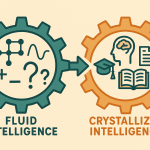
In adulthood, IQ remains relatively stable, though specific areas like processing speed and short-term memory can begin to show gradual decline. Crystallized intelligence — the ability to use learned knowledge and experience — often remains stable or even improves. See fluid vs. crystallized intelligence for the full explanation of why these two types of intelligence age so differently.
Senior Years IQ (60+ years)
IQ in older adults can decline, particularly in fluid intelligence (the capacity to reason through novel problems). Experience and accumulated knowledge, however, often compensate for this — which is why many people continue to perform strongly in familiar domains well into later life.
See Where You Score →
Factors That Affect IQ at Every Age
1. Genetics
Genetics play a significant role in determining IQ, with research suggesting 40–80% of intelligence can be attributed to hereditary factors.
2. Environment
Quality of education, socio-economic status, and access to learning resources all meaningfully shape IQ development.
3. Nutrition
Proper nutrition matters at every age, but especially during prenatal development and early childhood.
4. Health
Chronic illness, mental health conditions, and neurological issues can all influence measured IQ.
5. Education and Cognitive Training
Formal education and cognitively stimulating activity have been shown to support and even boost IQ over time — see can you increase your IQ? for the science behind this.

Does IQ Really Decline With Age?
The honest answer is both yes and no. Certain abilities — processing speed and short-term memory among them — can decline with age. Others, like vocabulary and general knowledge, tend to remain stable or even improve. This is best explained by the distinction between:
- Fluid intelligence — peaks in early adulthood, then gradually declines.
- Crystallized intelligence — continues to grow through middle age and often into later years.
For the full picture, including charts and data on cognitive peak, read does IQ decrease with age?
Key point: a drop in one type of IQ measure (like fluid reasoning speed) doesn't mean overall intelligence collapses — crystallized knowledge frequently offsets it.
The Flynn Effect: Are We Getting Smarter?
Named after researcher James R. Flynn, the Flynn Effect refers to the observed rise in average IQ scores across generations — roughly 3 points per decade, driven by better education, improved nutrition, and more cognitively stimulating environments. It's a useful reminder that "average IQ by age" is also, in part, a moving target across generations, not just across an individual lifetime.
How to Maintain and Support Your IQ as You Age
Regular exercise
Promotes brain health and neurogenesis. See exercise and IQ.
Healthy diet
Omega-3 fatty acids, antioxidants, and balanced nutrition support brain function.
Mental stimulation
Reading, puzzles, strategy games, and learning new skills.
Sleep hygiene
Quality sleep is crucial for memory consolidation. See sleep and IQ.

Common Myths About IQ and Age
1. "IQ is fixed"
While IQ is relatively stable, it can shift with interventions and lifestyle changes over time.
2. "IQ reflects all types of intelligence"
IQ primarily measures analytical intelligence — it doesn't account for creativity, emotional intelligence, or social skill. See emotional intelligence vs IQ.
3. "High IQ equals success at any age"
High IQ can support academic and professional success, but perseverance, emotional intelligence, and interpersonal skills matter just as much — often more so, over a full career. See what IQ is needed for Mensa for how rare very high scores actually are.
Conclusion
Understanding average IQ by age offers insight into how intelligence develops, peaks, and changes across a lifetime. Genetics provide the blueprint, but lifestyle, education, and environment all meaningfully shape cognitive health at every stage. IQ isn't just a number — it's one reflection of mental agility, learning potential, and adaptability, and staying informed can help you protect your cognitive edge at any age.
FAQ: Average IQ by Age
What is the average IQ by age?
Average IQ ranges from about 60–70 in toddlers (2–4 years) up to 100–115 during peak early adulthood (20–29 years), then gradually settles between roughly 75–100 through the senior years. IQ tests are age-normed, so a score of 100 always represents "average" for that specific age bracket.
At what age is IQ the highest?
Raw cognitive performance, particularly processing speed and fluid reasoning, tends to peak in the late teens through the twenties, roughly ages 20–29. Crystallized intelligence, built from accumulated knowledge and experience, can continue to grow well beyond this age.
Does IQ decline with age?
Some cognitive measures, especially processing speed and short-term memory, can decline gradually with age. However, crystallized intelligence — vocabulary, general knowledge, and experience-based reasoning — often remains stable or continues to improve well into later life.
Why are IQ tests age-normed?
IQ tests are age-normed so scores can be fairly compared within the same developmental stage. A 6-year-old and a 30-year-old have very different baseline cognitive abilities, so each is scored against people of a similar age rather than the population as a whole.
Can you improve your IQ as you get older?
To a degree, yes. While genetics set a baseline, regular exercise, quality sleep, a nutrient-rich diet, and ongoing mental stimulation such as reading, puzzles, or learning new skills can all support and help preserve cognitive function with age.

Reviewed and updated for 2026. Ranges synthesize established psychometric literature on age-normed IQ testing, fluid/crystallized intelligence, and the Flynn Effect.